

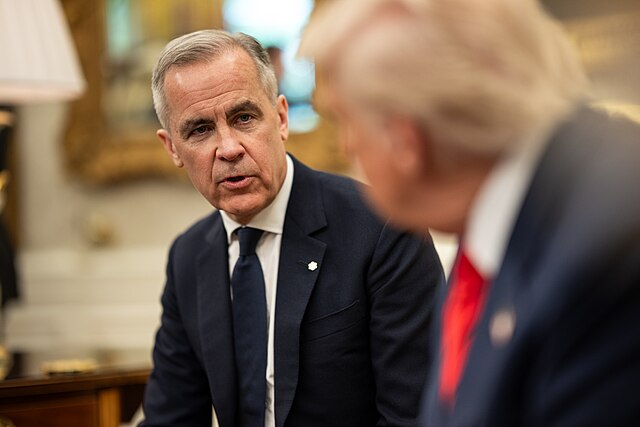
Prime Minister Mark Carney’s short visit to Washington D. C. didn’t bring much-anticipated tariff relief. However, Carney carried back home a bouquet of promises that something nicer lay ahead for Canada. Trump was non-committal on lifting tariffs on automobiles, steel, and aluminium. But he showered Carney with praises and even declared that the people of Canada would love America and Americans again: something that was picked up by the Canadian side as an indication that Trump would soften his stand against Canada. But when: that remains a million-dollar question.
On Wednesday, Carney faced a hostile Opposition in Parliament immediately upon his return. Pierre Poilievre, the leader of the Conservative Party and also the Leader of the Opposition in the House of Commons, accused the Prime Minister of betrayed the interests of Canadian workers by promising to invest $1 trillion in American enterprise over the next five years in exchange for a suitable trade deal with the United States. “The Prime Minister went pathetically to the White House to offer a trillion-dollar gift, bowing before the President in weakness,” Poilievre said during the Question Hour on Wednesday.
Carney said in his response that Canada already has the best deal possible with the US in the form of CUSMA, and a better one is coming. While the treasury bench thundered in applause, the Opposition benches didn’t quite share the approval. In fact, Bloc Quebecois leader Yves-Francoit Blanchet unleashed a fiery salvo at the Prime Minister, calling his trip nothing but an opportunity to exchange pleasantries. “The great negotiator is again coming back into the country, the tail between his legs. When will he stun us? When will he impress us?” Blanchet said in French, as reported by The Globe and Mail.
Carney contested the claim that nothing worthwhile was achieved and said his was a “meeting of the minds” with Trump for a deal that was coming that would be in the best interests of Canada.
News agency Reuters reported that Carney highlighted an “active effort” to outline an auto agreement in his discussions with the American side. The Associated Press reported that the PM raised the idea of reviving the Keystone XL pipeline as part of a broader energy compact—an overture Trump was reportedly open to entertaining, despite the project’s 2021 cancellation under President Biden. This project was contentious in its time and the recently-deceased Hollywood star Robert Redford was a trenchant critic of it. Carney appears to have played a gamble here: any Keystone reboot would encounter environmental opposition at home and in the U.S., but Alberta and industry allies view it as leverage inside a larger trade-energy bargain. British Columbia is expected to oppose this should Trump decided to play ball.
Politico’s analysis underscores the structural shift in the bilateral relationship that Carney himself flagged: an increasingly transactional “new normal” in which “America First” does not necessarily mean “America alone,” but does require Ottawa to price in harder quid-pro-quo bargaining from Washington. That framing helps explain the push for narrow, sector-by-sector fixes rather than a sweeping grand bargain.
Provincial opinion on this has been divided, though. Ontario Premier Doug Ford said he wants to see Canada hit back hard should Trump not lift the tariffs, while Alberta Premier Danielle Smith favoured Carney’s conciliatory approach, saying it was the best way to deal with someone like Trump.
As Carney himself said on Tuesday, Canada can, at this point, hope for incremental changes in its favour, nothing sweeping. However, this seems to be only the beginning of Carney’s leadership test.
Image: Wikimedia Commons